

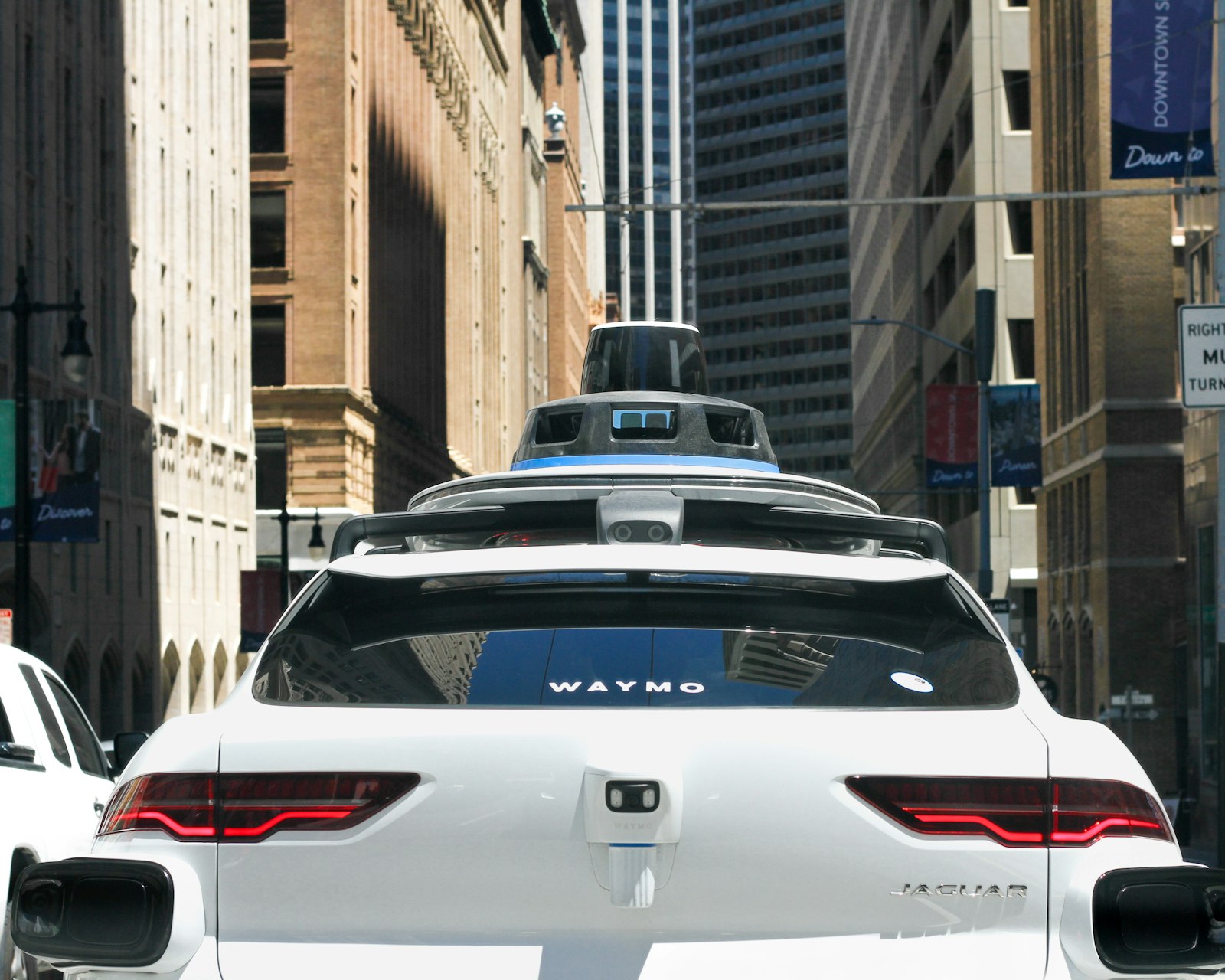
Waymo has shown how much computing power now sits beneath a robotaxi’s floor. The Alphabet unit has published the first details of its own 5-nanometer chip, which preprocesses sensor data inside the vehicle. It may sound like another entry in the AI-chip race. It actually explains something more fundamental: autonomous driving is not simply a large language model with a steering wheel. It is a real-time system that has to make safe decisions at every intersection before the next second is gone.
Key takeaways
- Waymo has introduced a custom 5nm ASIC that processes raw camera, lidar, and radar data in its robotaxis.
- The chip is designed to deliver more than 1,000 TOPS for front-end processing and AI models while operating onboard the vehicle.
- It does not replace the full compute stack: Waymo still uses CPUs, GPUs, and accelerators from partners including Nvidia and AMD.
- The important advantage is low latency, energy efficiency, and redundancy, not a headline performance number alone.
- The move shows why robotaxi companies increasingly have to think like systems manufacturers: sensors, silicon, software, and vehicle form one product.
The chip sits where the decision is made
Waymo says its new application-specific chip handles the large volume of raw data before it reaches the driving system’s core machine-learning component. Cameras, lidar, and radar see different parts of the same traffic situation. Their data must be combined, cleaned of noise, and prepared so that a model can infer a scene relevant to driving. The ASIC is tailored to that work, including sensor fusion, temporal denoising in low light, and neural networks ranging from sparse convolutional models to transformers.
The key difference from many cloud applications is time. A recommendation system can calculate again after half a second. A driverless vehicle must turn pixels and measurements into an action within milliseconds. Waymo calls this path pixels to actuation. Because there is no human driver to serve as a fallback, the computation must be not only fast but predictable. That is why it runs in the vehicle instead of taking a trip to a data center first.
More than a TOPS number
Waymo puts the custom chip’s performance at more than 1,000 TOPS, or more than one trillion operations per second. Such figures work well on slides, but by themselves they say little about a safe driving decision. Memory access, data paths, numerical precision, power use, and whether the architecture remains stable under sustained load in summer and winter matter too. Waymo therefore describes its system as designed for low latency, resistance to vibration and temperature extremes, and redundancy.
That redundancy is not merely a marketing word. Waymo describes two independent compute units that normally run parallel workloads and can take over when a fault occurs. In a data center, a service can move to another server. A car has no such escape route. It must remain controlled even if a component fails or individual sensors see less clearly. A custom chip is therefore useful only when it fits into an overall architecture that anticipates failure.
Not a divorce from Nvidia
The easy headline is that Waymo builds its own hardware, so Nvidia loses a customer. That is too simple. Waymo explicitly names Nvidia alongside AMD, Micron, Samsung, Sandisk, Socionext, and TSMC as partners in its compute platform. The custom component performs a specialized task at the beginning of the data pipeline; the overall system remains heterogeneous. CPUs coordinate operations and data movement, while different accelerators serve different AI workloads.
That division of labor is a signal for the chip industry. When a problem is tightly defined, high-volume, and sensitive to energy use, an ASIC can be more efficient than a general-purpose accelerator. That applies to robotaxis as well as parts of data-center AI. General-purpose GPUs remain important because models, software, and requirements change quickly. Specialized hardware gains where a company knows its workload precisely and repeats it at massive scale. Waymo has accumulated years of real driving data and built its own sensor architecture, the conditions that make this move plausible.
Why it matters for scale
Waymo says it has increased the compute power of its platform twentyfold in eight years. But the next growth stage does not depend on more performance alone. A robotaxi needs to be affordable to manufacture, efficient with electricity, spacious enough for riders, and reliable through heat, cold, and vibration. Integration with the vehicle’s liquid-cooling system and lower latency are therefore at least as important as a raw performance figure.
Waymo’s decision to publish these technical foundations fits a market in which autonomous ride services want to be more than pilot programs. Companies have to show that their systems can be manufactured and operated repeatedly, not only deliver impressive demonstrations. A custom chip is not proof of safety. It does show which parts of the cost and performance equation Waymo wants to control itself.
The computer becomes part of the vehicle
The most interesting point is not who builds the biggest chip. It is that the car is becoming a physical AI system. Its intelligence emerges from sensors, power delivery, cooling, data paths, software, and clear rules for failures. Anyone evaluating robotaxis should therefore look beyond model names or individual driving videos. The central engineering achievement is connecting all those parts under real road conditions. Waymo’s ASIC is a visible component of that connection, not a shortcut around it.