

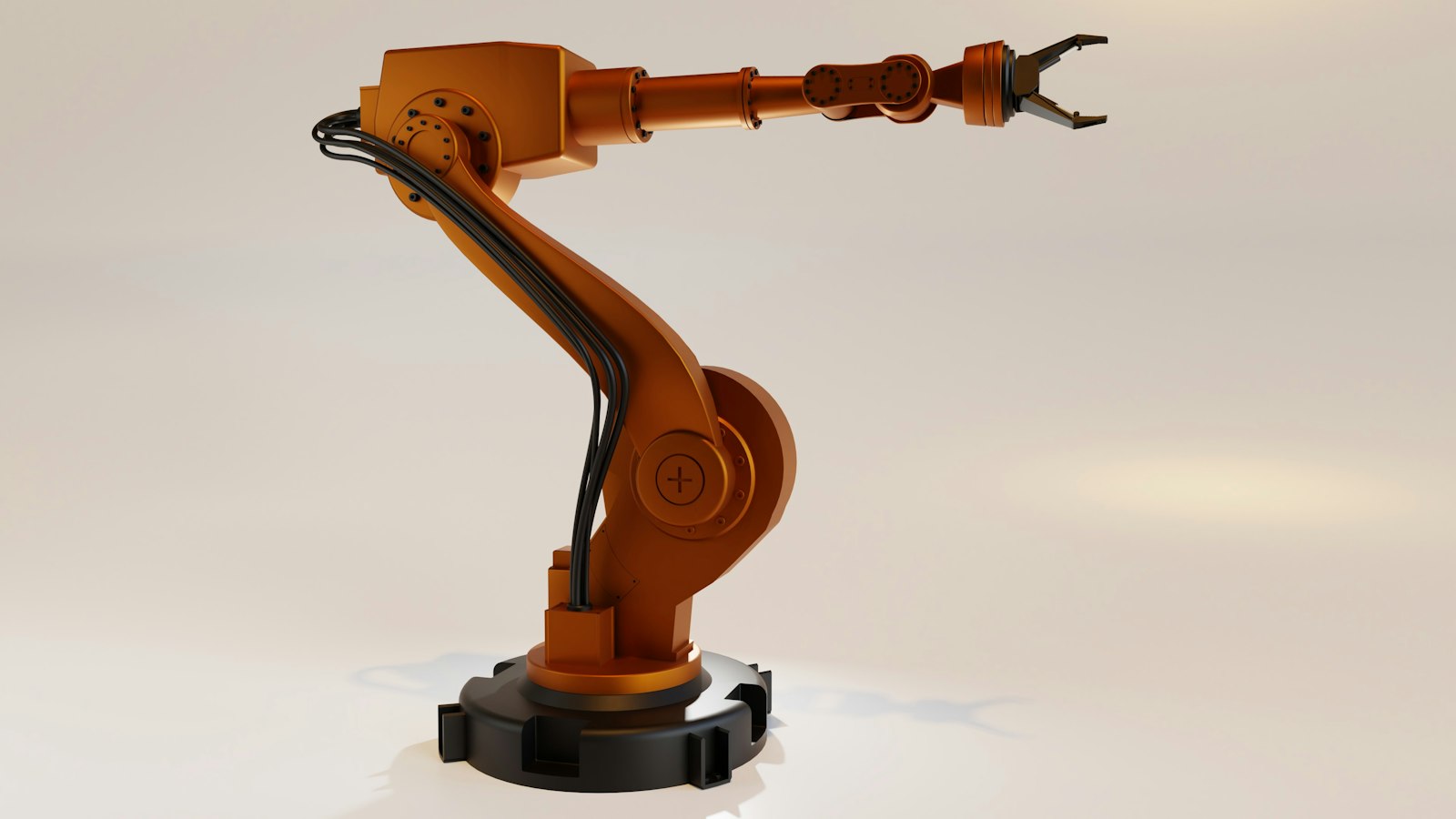
Black Forest Labs, based in Freiburg, Germany, is best known for image generators. On September 23, the company released FLUX 3 Action, an open model that controls robot arms: it looks through cameras, understands an instruction in plain language and plans the next movements. The weights are freely available on Hugging Face, the model runs on a graphics card with 24 gigabytes of memory, and it can be adapted to a new arm with a few hundred examples. That puts a robotics model that, by the company’s account, ranks among the best within reach of universities, startups and hobbyists.
Key takeaways
- FLUX 3 Action is an open model with 7 billion parameters that turns camera images, joint positions and a text instruction into the robot’s next 32 movements.
- On NVIDIA’s RoboLab-120 simulation benchmark, Black Forest Labs reports a 42.92 percent task success rate, ahead of NVIDIA’s own Cosmos3-Nano-Policy at 36.8 percent. The leaderboard had not been independently updated at launch.
- In a blind test by Positronic Robotics on a real Franka arm, 28 of 30 attempts succeeded.
- With FP8 quantization the model fits on 24 GB graphics cards, and a ready-made setup exists for the open-source SO-101 hobby arm, whose parts cost about 124 euros according to its bill of materials.
- The license allows non-commercial use and commercial use by companies with less than 5 million dollars in annual revenue; larger companies need a separate agreement.
A model that predicts motion like a video
Most robotics models of recent years are so-called vision-language-action models: language models that read images as well as text and output control commands at the end. Black Forest Labs takes a different route and calls its system a world action model. The idea is a model that predicts not only the next movements but also what the scene will look like afterward. Actions and future video frames are generated in a single joint step.
That reflects where the model comes from. According to the developers’ Hugging Face blog post, FLUX 3, the base model Black Forest Labs introduced in July, was trained on more than 95 percent video data. A model that has seen millions of clips of hands grabbing cups or closing drawers brings a rough understanding of how things move. For the robotics version, the team added teleoperation data from 14 different robot types, first-person footage of human hands and recordings from video games.
In operation, the model receives the current camera images, the joint positions and an instruction such as “Put the sponge in the bowl.” It returns 32 movement steps, about two seconds of motion on the standard robot arm. The robot executes the first few, looks again and replans. During control, the predicted video frames are not even decoded, which saves compute. Alibaba’s open model Qwen3-VL-4B handles the text understanding.
What the numbers show
RoboLab-120 is an NVIDIA simulation benchmark with 120 tasks. Black Forest Labs reports a 42.92 percent success rate for FLUX 3 Action. According to the same table, NVIDIA’s Cosmos3-Nano-Policy with 16 billion parameters reaches 36.8 percent, the closed OASIS WAM 39.0 percent and Physical Intelligence’s well-known π0.5 model 28.0 percent. Speed matters too: in FP8, FLUX 3 Action runs between 1.52 and 3.95 times faster than Cosmos 3 Nano depending on the graphics card, with less than half the parameters.
Two caveats apply. First, these are the vendor’s own figures; VentureBeat noted at launch that NVIDIA’s public leaderboard did not yet list the model. Second, Black Forest Labs itself gives slightly different values: the running text on its model page cites 42.2 percent for the faster, distilled variant. That does not change the ranking, but it shows how tight the field is.
The test on real hardware is more telling. Positronic Robotics had the model solve ten everyday tasks on a Franka arm in its lab, such as putting a cube in a bowl, placing a fork on a plate or closing a drawer, three times each with 240 seconds per attempt. The operator did not know which model was in control. FLUX 3 Action succeeded in 28 of 30 attempts, Cosmos 3 Nano in 27, DreamZero in 20 and π0.5 in 13. These results, too, are published by Black Forest Labs, and they cover ten simple pick-and-place tasks, not a factory floor. How far simulation training carries was already the question with World Labs’ approach, where the real test also lies in the physical world.
Who can make use of it
The real advance is accessibility. According to the model card, FLUX 3 Action needs about 32 gigabytes of GPU memory at full precision; with FP8 quantization and the text encoder offloaded, it fits on 24 GB cards. That is expensive enthusiast hardware, but not a data center. Three versions are available: a base model for further training, a policy for the Franka arm from the DROID dataset and one for the SO-101.
The SO-101 is an open-source, 3D-printable robot arm developed by The Robot Studio together with Hugging Face. The project’s bill of materials lists about 124 euros in parts for one arm and about 226 euros for the leader-follower pair used to demonstrate movements. FLUX 3 Action is integrated into Hugging Face’s LeRobot robotics library, including recipes for efficient fine-tuning. According to the developers, the SO-101 version was adapted with roughly 200 hand-guided demonstrations covering a few pick-and-place tasks. Anyone working at a university, in a makerspace or at a small automation shop can now teach their own tasks with a few hundred euros of hardware and an existing graphics card.
Side experiments show how broadly the approach is designed: the same weights played a Quake-style shooter and an Out Run-style racing game, and another version flew a drone through unfamiliar rooms. Black Forest Labs explicitly calls these early experiments, not finished capabilities.
License and safety: the fine print
Open does not mean open source in the strict sense here. The weights are released under the FLUX Kommunity License. It permits research and personal use, as well as commercial use by companies whose annual revenue, including affiliates, is below 5 million US dollars. Everyone else needs a separate license, which according to the terms may involve fees or revenue sharing. Military use and surveillance are excluded, and Black Forest Labs reserves the right to terminate the license upon notice. For a midsize manufacturer planning to build a production line on it, that is a matter for the legal department.
The safety note on the model card is equally clear: nothing in the model limits joint velocity, force or workspace. Anyone controlling an arm with it has to set those limits in the robot controller and provide an emergency stop. Use without human oversight in situations where people could be endangered is explicitly out of scope.
The bigger picture: a German player in the robotics race
The field of open robotics models has become crowded this year: NVIDIA released GR00T N1.7 in April and the Allen Institute for AI followed with MolmoAct 2 in May, while Google DeepMind keeps the on-device version of Gemini Robotics limited to selected testers. Black Forest Labs, founded in 2024 by researchers behind latent diffusion and Stable Diffusion and valued at 3.25 billion dollars in December 2025 according to VentureBeat, brings its own strength: a video model that has already learned a great deal about how things move in the world. Early industrial trials had already taken place with Swiss startup mimic robotics in Audi production environments.
The decisive test is still ahead: whether outside teams can reproduce the results on their own robots, and whether NVIDIA’s leaderboard confirms the numbers. Until then, FLUX 3 Action is above all an offer to everyone who has so far been stopped by the barrier to entry. A robot arm for a little over 200 euros, a gaming graphics card and a few hundred demonstrated movements are enough for a serious attempt with a model that, by the vendor’s account, leads the field. That this offer comes from Freiburg matters more for European robotics than any benchmark ranking.
Sources
- Black Forest Labs: FLUX 3 Action – A 7B World Action Model for Robot Control
- Hugging Face Blog: FLUX 3 Action – a world action model you can fine-tune
- Hugging Face: Modellkarte FLUX 3 Action DROID
- Black Forest Labs: FLUX Kommunity License v1.0
- VentureBeat: Black Forest Labs debuts FLUX 3 Action
- The Decoder: Black Forest Labs launches FLUX 3 Action
- The Robot Studio: SO-ARM100/SO-101 auf GitHub