

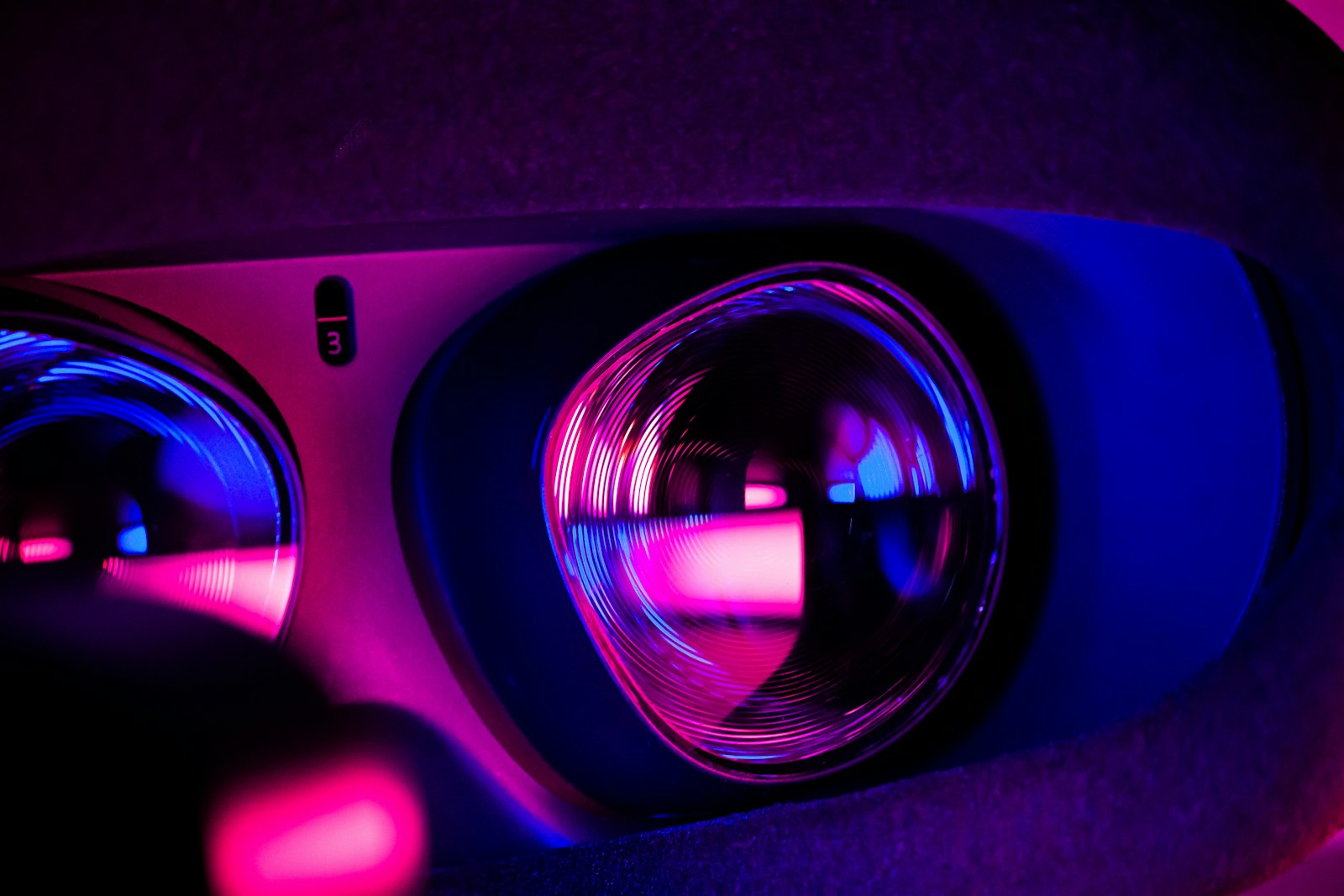
Until now, experiencing virtual reality meant strapping a box weighing about a pound to your face. At its Connect conference on September 23, 2026, Meta unveiled an alternative: Meta VR Glasses, a VR device weighing about 100 grams that offloads computing power and battery to a pocket-sized puck. It is due in spring 2027 for $1,299. Early testers were surprised at how well control by gaze and finger taps works, while also pointing out what the glasses are not built for.
Key takeaways
- According to Meta, the Meta VR Glasses weigh about 100 grams, one-fifth of a Quest 3. The chip, battery and storage sit in a separate puck connected to the glasses by an optical tether.
- Two micro-OLED displays with 37 pixels per degree deliver an unusually sharp image, including for text, according to consistent reports.
- There are no controllers required: you navigate with your eyes, small finger gestures and voice, and Meta’s AI assistant is built right into the operating system.
- The focus is on movies, live sports and a mobile workspace with multiple virtual screens, less on gaming.
- The glasses go on sale in spring 2027 for $1,299.99; there is no word yet on availability in Germany or a euro price.
The idea: take the headset apart
The trick behind the low weight is a division of labor. The glasses carry only the sensors, lenses and displays. Everything heavy goes into the puck: Qualcomm’s new Snapdragon Reality Elite chip, the battery and the storage. The puck clips to a pocket or bag. According to Meta, that makes the glasses five times lighter than the Quest 3; the battery lasts up to three hours of video playback and supports 45-watt charging. Head straps and pressure on the forehead and cheeks, the classic annoyance of VR headsets, are gone.
It does not come entirely weightless, though. According to Engadget, the puck weighs about 300 grams, and reporter Karissa Bell noticed significant heat during her demo, which could become uncomfortable in a pocket. The Meta VR Glasses also look more like flat goggles than ordinary glasses. The lenses are not see-through: outward-facing cameras show the surroundings as a color image on the display, complemented by open sides that leave your peripheral view clear.
Sharp, but with a narrower field of view
The picture is remarkable. Meta talks about a “5K Infinite Display” based on micro-OLED panels with 37 pixels per degree, plus Dolby Vision and Dolby Atmos spatial audio built into the frames. Engadget cites a resolution of 2,412 by 2,288 pixels per eye and a 70-degree field of view. Bell writes that it was the sharpest mixed reality display she can remember seeing; she could not make out a single pixel. Tom’s Guide also praises how legible websites and code are, a weakness of many smart glasses.
The price of the compact design is the field of view. If you are used to classic VR, the glasses feel less immersive: the virtual world does not fill your entire view. When working with three virtual windows, Bell had to turn her head to see each one. For people who easily get motion sick in VR, though, that could even be an advantage, she notes.
Control with a glance and a tap
The glasses no longer need controllers; they can be paired only as an option. You look at an icon and tap your thumb and index finger together; swiping your thumb along your finger scrolls. Your hands can stay in your lap because there are sensors on the underside of the glasses too. Both testers describe the controls as intuitive, with some caveats: at Tom’s Guide, it was not always clear which icon was selected, because the highlight only shows up as a slight brightening. On top of that, Meta’s AI assistant is built into the operating system. Starting movies, opening apps or rearranging the workspace is also supposed to work by voice. That fits with Meta bringing its AI agent Muse to more and more devices: to its AI glasses and to the Muse Charm keychain that Mark Zuckerberg also showed at Connect. In Germany, however, Muse is not available yet.
What the glasses are for
Meta pitches the device as a personal cinema, courtside seat and office. The glasses are the first VR device with IMAX Enhanced certification. Partners include Disney+, Prime Video, YouTube and ESPN. Once the glasses launch, more than 100 live sports events a year are set to be streamed in immersive form. For work, the glasses connect to a Mac or PC and display several large virtual screens. A feature called “Surface Keyboard” projects a keyboard and touchpad onto any tabletop. Both testers found typing without tactile feedback took some getting used to, though. Hologram calls are also new: a photorealistic likeness of the user with real-time facial expressions is supposed to work in common apps from WhatsApp to Zoom. For gamers, more than 75 titles playable with hand gestures alone will be available at launch, plus hundreds more via Xbox Cloud Gaming.
Outlook: a path to everyday VR
At nearly $1,300, the glasses are not a mass-market product, but they cost about half as much as an Apple Vision Pro. More interesting than the price is the direction. According to Counterpoint Research, Meta holds nearly 70 percent of the VR market, and with this device it is moving away from the headset as the basic form. Xreal is also relying on a separate compute puck for its upcoming Aura glasses; what is new is that the market leader is pairing that approach with a high-resolution, full-fledged VR system. Whether the glasses succeed will come down to three things by spring: whether the field of view is enough for everyday use, whether the warm puck is a nuisance in your pocket, and whether Meta delivers enough content that a flat TV cannot match. If you have been curious about VR but put off by the weight and pressure on your face, keep an eye on the launch.