

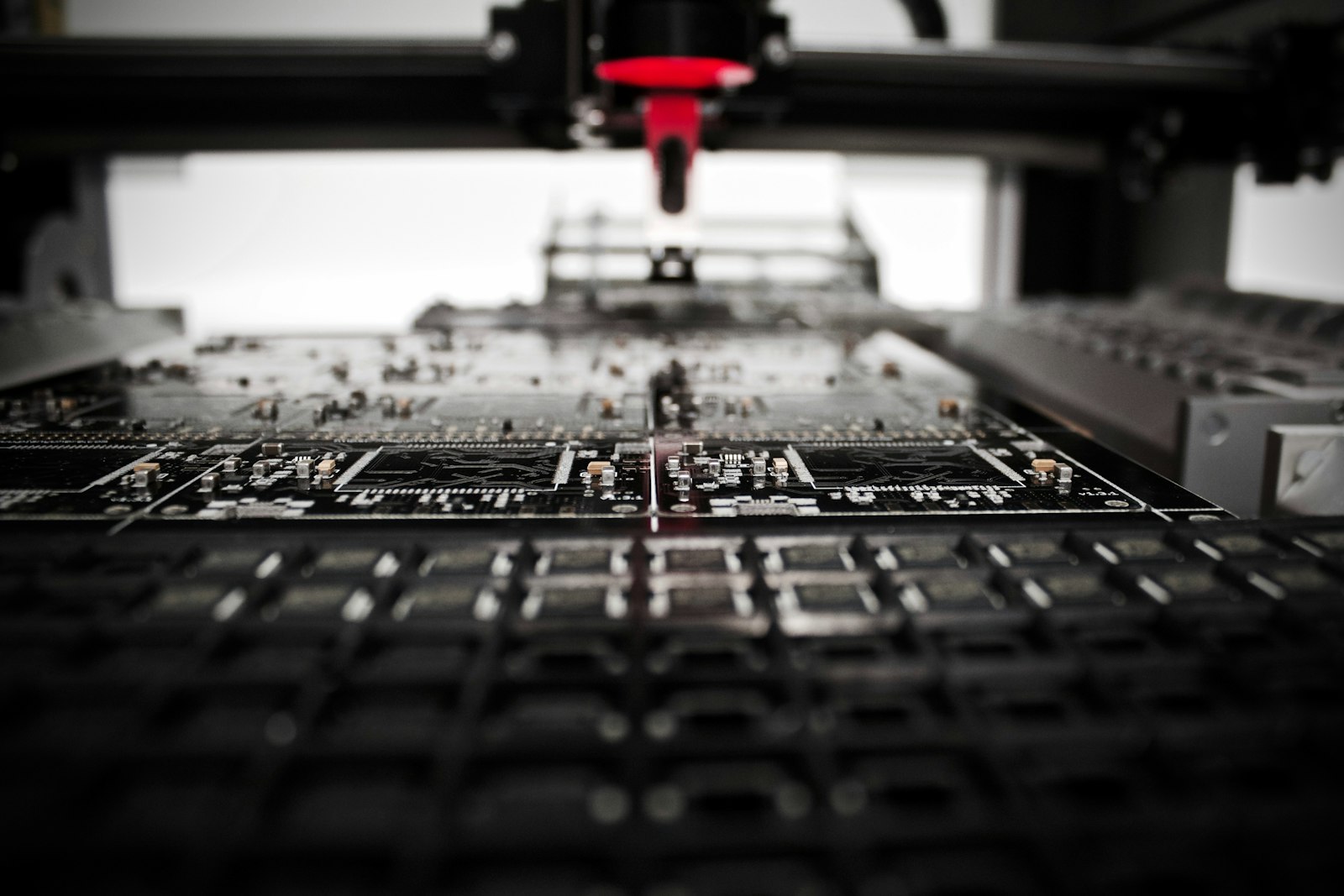
A language model that summarizes a document can be wrong. An agent that controls pipettes, robot arms, and lasers cannot be wrong in the same harmless way. That is the threshold Anthropic’s new Model Hardware Standard, or MHS, is meant to address. The standard is intended to give AI agents a shared, controllable interface to programmable lab and manufacturing equipment. This is a research preview, not a turnkey system for autonomous factories. But the idea targets a real bottleneck: many automated labs are held back less by a lack of AI than by incompatible equipment and laborious one-off integrations.
Key takeaways
- On August 27, 2026, Anthropic introduced an early Model Hardware Standard for research labs and advanced manufacturing.
- MHS standardizes how agents discover devices, read measurements, write settings, and observe predefined safety limits.
- Early partners are testing uses from protein assays to laser stabilization in quantum computers.
- The standard does not replace expert staff or physical understanding. Anthropic itself acknowledges the spatial and practical limits of language models.
Why a shared driver matters more than a new agent
A modern lab rarely has just one device and one piece of software working together. Liquid handlers dispense samples, robot arms move plates, readers measure results, and cameras and sensors provide feedback. Each instrument usually comes with its own interface, data format, and safety logic. Building a workflow from that mix often takes specialists and weeks or months of integration. An agent cannot talk its way around those breaks. It needs a reliable translation layer between its plan and the machine.
MHS tries to standardize that layer. The specification describes a driver with simple operations such as read and write. A device can report its temperature, for example, or accept a permitted temperature adjustment. It also carries machine-readable information about capabilities, adjustable parameters, and safety limits. The important detail is the knowledge that otherwise lives in manuals or in an experienced technician’s head: a robot arm has weight, reach, and boundaries. An agent should not have to guess those properties; it should receive them through the driver.
That makes MHS more like a shared connector than an unusually clever lab technician. Anthropic says the standard is model-agnostic and can be accessed through protocols including MCP, command line tools, and APIs. In principle, that makes it useful to different agents and manufacturers. It is also a prerequisite for meaningful review: when devices communicate through defined commands, allowed actions, states, and stop conditions can be specified more clearly than in a collection of custom scripts.
Early cases show the promise and the scale of the task
Anthropic highlights several pilot projects. At Genentech, MHS coordinated a liquid handler, robot arm, and plate reader in a proof of concept for a protein assay. QuEra used the approach for parts of its laser system in quantum computers; Anthropic says an agent restored the precise laser lock without human intervention in 99.3 percent of cases. These are notable examples, but they do not prove that a general-purpose agent can reliably operate every lab tomorrow. They mainly show where standardization pays off: in recurring, well-instrumented workflows with clear measurements and defined interventions.
Independent Reuters reporting also frames MHS as a framework for scientific research and advanced manufacturing, not a finished mass-market product. That context matters. Industry and research have automated equipment for decades. What is new is the prospect that an agent can orchestrate multiple systems through one shared description, observe measurement data, and identify fault chains more quickly. That could shorten experiment setup and improve the monitoring of overnight routines. It also shifts responsibility: who defines allowed commands, who validates the driver, and who stops the workflow when sensors disagree?
Physical safety cannot be prompted into existence
Anthropic says MHS will use built-in safety limits and that the research preview will develop additional evaluations before the standard is released as open source. That is the right order. In the digital world, a misguided agent can move files or mishandle a browser; we have already covered why agents in a browser become different once they have real tools. In a lab, a wrong command can ruin samples, damage equipment, or endanger people. The relevant question is therefore not whether a model produces a plausible explanation, but whether a system can act only within verifiable boundaries.
The announcement provides a useful reality check here as well. Anthropic writes that Claude needed guidance to recognize foaming protein samples as a physical rather than a software problem. Language models learn about the world mainly from text and images, not through embodied experience. A standard can carry information and limits, but it cannot replace missing shop-floor knowledge. For operators, approvals, emergency stops, calibration, access controls, and traceable logs remain core parts of the system, not follow-up work after a pilot.
Outlook: Competition moves to dependable interfaces
MHS is not yet an open industry standard, and it still has to prove that manufacturers and labs will support it broadly enough. Its larger significance is already clear, though. The next stage of AI agents will not be decided by who shows the slickest robot-arm demo. It will be decided by whether different devices can work together safely through descriptions that are testable and controllable. If MHS supplies that foundation, it could make experiments and manufacturing workflows genuinely more accessible. If it does not, the agent will remain an eloquent visitor in the lab, unable to open the door to the next machine.